Table of Contents
- Overview
- Role
- Problem
- Goal
- Solution
- Technical Implementation
- Team
- Challenges and Learnings
- Final Thoughts
Overview
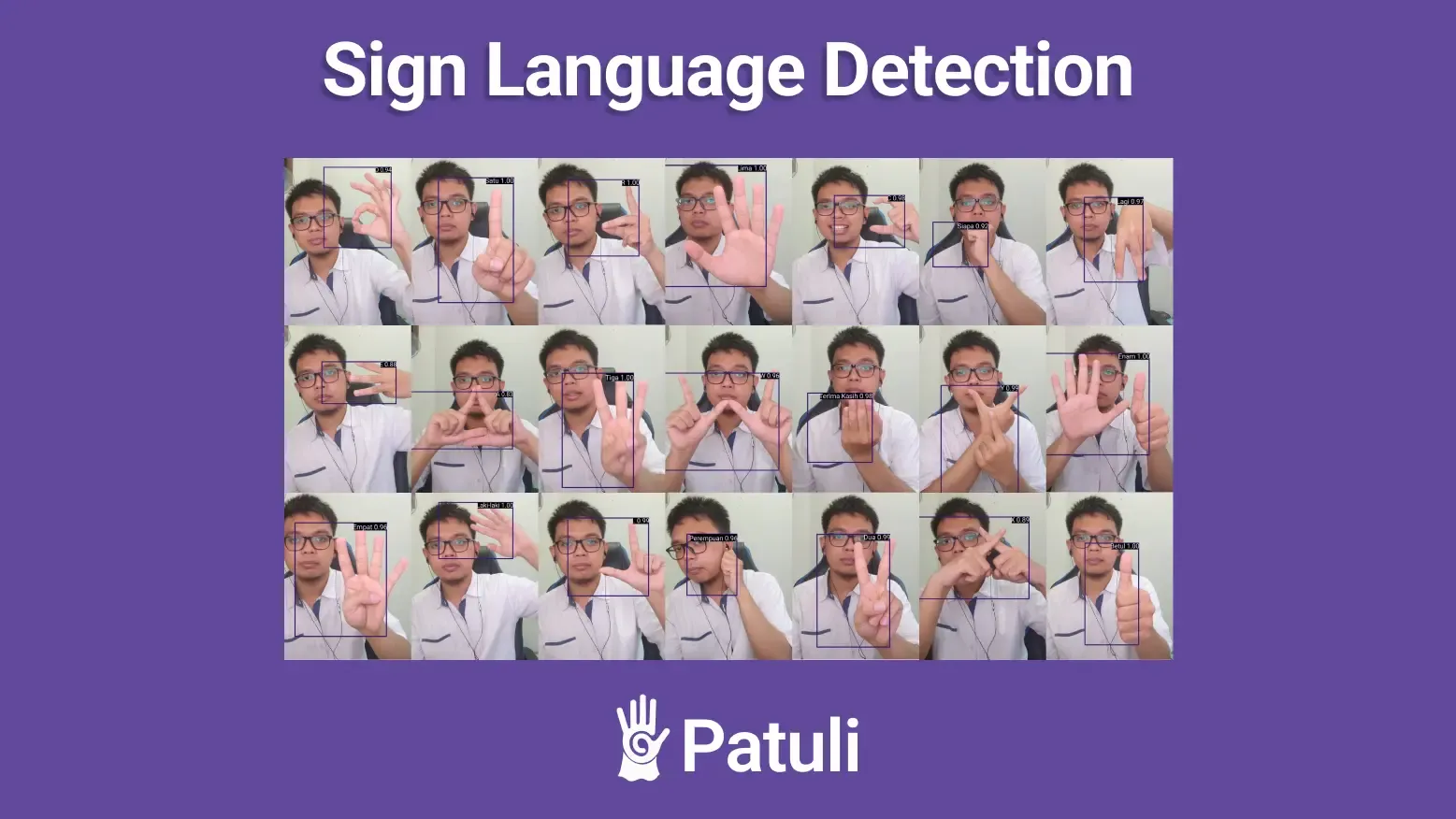
Patuli (Pahlawan Tuli) is an Android application designed to help users learn and communicate using Bisindo (Indonesian Sign Language) gestures through integrated machine learning. Built as a capstone project for Bangkit Academy 2023 — a program led by Google, GoTo, and Traveloka — the app brings real-time sign language recognition to mobile devices, improving accessibility for the deaf and hearing-impaired community in Indonesia.
Role
Machine Learning Engineer
Problem
Communication barriers between hearing and hearing-impaired individuals remain a significant accessibility challenge in Indonesia:
- Most Indonesians are unfamiliar with Bisindo, limiting meaningful interaction with the deaf community.
- Existing sign language learning resources are scarce, static, and not interactive.
- No accessible mobile tool existed for real-time Bisindo gesture translation in the Indonesian context.
Goal
- Build an accurate Bisindo gesture recognition model deployable on Android devices.
- Create an interactive learning platform that teaches sign language through modules and gamification.
- Enable real-time translation of Bisindo movements to bridge communication gaps.
- Make the application lightweight enough to run on-device via TFLite without requiring an internet connection.
Solution
Core Features
- Learning Modules: Structured lessons covering Bisindo alphabets, numbers, and common words.
- Gamification: Interactive challenges to keep users engaged and motivated throughout their learning journey.
- Real-Time Translation: Live camera-based gesture detection that translates Bisindo signs instantly, enabling direct communication with hearing-impaired individuals.
Repositories
- Machine Learning: Patuli-ML
- Mobile Development: Patuli-Android
- Cloud Computing: Patuli-Cloud
Technical Implementation
Machine Learning
- Base Model: MobileNetV2 pre-trained on ImageNet, fine-tuned via transfer learning on a custom Bisindo gesture dataset.
- Accuracy: Achieved over 80% accuracy on the validation set across gesture classes (alphabets, numbers, words).
- Deployment: Model exported to TFLite format for efficient on-device inference on Android.
- Framework: TensorFlow / Keras for training; TFLite for mobile deployment.
Android Integration
- TFLite model integrated directly into the Android app for real-time camera-based inference.
- No network call required for gesture recognition — fully on-device processing ensures low latency and offline capability.
Cloud Computing
- Backend services deployed to support user authentication, progress tracking, and learning module content delivery.
Team
Team ID: C23-PS037 · Bangkit Academy 2023
| Name | Learning Path |
|---|---|
| Ammar Sufyan | Machine Learning |
| Fauzan Farhan Antoro | Machine Learning |
| Belvin Shandy Aurora | Machine Learning |
| Benidiktus Valerino Gozen | Mobile Development |
| Vincentius Agung Prabandaru | Cloud Computing |
| Muhammad Imam Alif | Cloud Computing |
Challenges and Learnings
- Dataset Quality: Collecting a consistent, well-lit, and diverse dataset for Bisindo gestures was the most time-intensive part of the project. Variability in hand sizes, angles, and lighting required extensive augmentation.
- Model Size vs. Accuracy Trade-off: MobileNetV2 was chosen specifically for its balance between accuracy and model size, making it feasible for TFLite deployment without significant quality loss.
- Real-Time Performance: Optimizing inference speed on mobile required quantization and careful post-processing to maintain smooth frame rates during live camera detection.
- Cross-team Coordination: Collaborating across three learning paths (ML, Android, Cloud) under a tight capstone deadline required clear API contracts and regular syncs.
Final Thoughts
- Transfer Learning Accelerates Delivery: Starting from a pre-trained MobileNetV2 backbone allowed the team to reach production-ready accuracy within the project timeline without training from scratch.
- On-Device AI Improves Accessibility: Running inference locally means the app works without internet, which is critical for users in areas with limited connectivity.
- Meaningful Impact: Building a tool that tangibly helps the hearing-impaired community made this one of the most rewarding projects to work on.